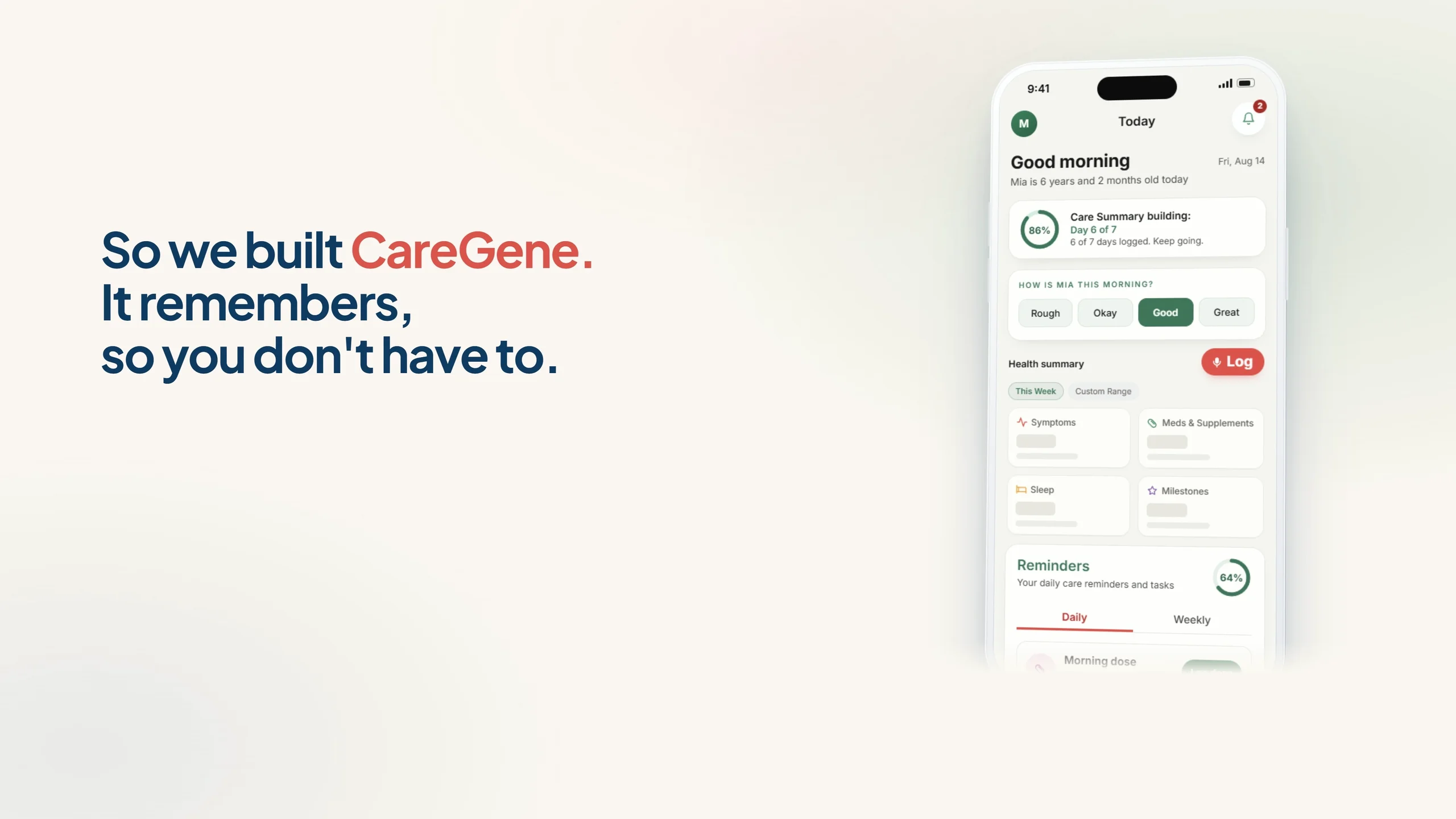
A short silent film of the CareGene app. A parent logs her child's day by voice, photo or tap, asks Sage to connect her health records and Apple Health, books a doctor's visit through Sage, and gets a pre-visit brief built from everything in her record.
Care coordination that survives the messy reality of rare disease.
The voice-first AI care coordinator for families with rare conditions.
Download on the App StoreCare coordination that survives the messy reality of rare disease.
The voice-first AI care coordinator for families with rare conditions.
Connects to MyChart and Apple Health.

One visit note is a snapshot. Your child’s care is a movie.
The Snapshot Trap
Disconnected Visits • Missing Context • Lost Time
The Full Movie
A silent thirty second tour of the CareGene app, in two parts.
Today. The CareGene Today screen. A greeting with your child's age, a care summary building on day 1 of 7, and a card offering to connect your child's hospital records in thirty seconds so growth, vitals and care team import on their own. Then the reminders list: supplement and medication reminders, each with a one-tap button to log the morning or evening dose, and a card to connect Apple Health for activity, sleep and heart rate.
Diary. The Living Diary. A symptoms entry for 18 July, a recorded doctor meeting of thirty-six seconds turned into three key takeaways, and eight supplements logged the same day. The add-to-diary sheet offers voice, photo, video, note, file and log, then eighteen more entry types including allergy, vaccination, heart rate, body temperature, energy, sleep, meal, symptom and medication, and Energy is chosen. The calendar filter shows July and August 2026 with the number of entries logged on every day, and a range dragged from 16 to 22 July returning seven days of records. Then a search. Typing "Tired" in Living Memory finds an energy level of 2 of 5 logged today at 1:18 PM, tiredness logged as a medium symptom at 1:15 PM, and a twenty minute nap on 11 September. Switching to For You and typing "Night" finds an afternoon mood of okay with the note "Rough night, much calmer this afternoon", paracetamol started yesterday, twice a day, and 0.24 litres of water on 10 September.
Continuous Timeline • Real-time Updates • Clinical Context
How CareGene works.
Capture
Voice-log moments between visits. Add a photo, a note, a vital. Sync the EHR. Everything lands in one place.
Connect
Sage organizes symptoms, medications, visits, and labs into one searchable timeline. The observations you log are ready to share with your team.
Prepare
Walk into the next appointment with a pre-visit summary your doctor can read in 30 seconds, with every line cited to a source you can show them.
Ask Sage
about your child’s care.
Every answer points back to the exact note or document it came from.
No black-box answers. Every claim is traceable to its source.
Log faster than paper
Speak or type symptoms, meds, and observations in seconds. Sage structures it for you.
Record doctor visits
With your doctor’s permission, one tap turns the appointment into key takeaways and action items.
Ask about your child’s history
Get instant answers from your child’s complete history: dosages, dates, decisions, anything.
Sample conversation with Sage, reproduced from the CareGene iOS app. Not a live record. Tags show where a sentence came from: H is your child’s record, D is your diary notes, M is medical literature and PM is a PubMed article.
You asked: Have my child’s seizures gotten better since the dose change, and what does the research say about seizures in PMS?
Sage answered: Your child's seizures have shown improvement since their Levetiracetam dose was changed to 1.5 ml (150 mg) twice daily on June 13 (H6). Their seizure severity has decreased from high on June 18 to low by July 29, and the frequency has dropped to about 1 event per week (H2). Research shows that seizures are common in Phelan-McDermid Syndrome, affecting about 43% of patients (M3).
Evidence-backed answer, 7 verified sources.
You asked: I’ve noticed more irritability lately, is that a known side effect for levetiracetam?
Sage answered: Yes, irritability is a well-documented side effect of levetiracetam, especially in children. Levetiracetam commonly causes neuropsychiatric adverse events in pediatric patients, including irritability and aggression (PM1). In your diary notes, you've observed that they get "pretty grumpy" before certain events and have been "cranky" when skipping naps (D2, D3, D5).
Evidence-backed answer, 5 verified sources.
You asked: Is my child getting enough sleep for their age?
Sage answered: Your child is averaging 8.6 hours of sleep per night, which falls below the recommended 10-13 hours for their age group (H1). Since your child has Phelan-McDermid Syndrome, sleep disturbances are commonly associated with this condition and may require specialized approaches (M3).
Evidence-backed answer, 3 verified sources.
Drag or hover to turn it. Use the left and right arrow keys to turn it, and the up and down arrow keys to scroll it.
Own Every Appointment.
Walk in with a pre-visit summary your doctor can read in 30 seconds.
Neurology Follow-Up
From Today's Visit Recording
Parent-Logged Changes (Since last visit)
Parent-generated summary from CareGene. Based on records logged by the parent for the child. Not a medical record. For discussion with your clinician. Generated June 14, 2026 at 9:42 AM.
Frequently Asked Questions
Everything you need to know about CareGene
What is CareGene and who is it for?
How do I get CareGene?
Is CareGene HIPAA compliant?
Is my child's data used to train AI models?
Does CareGene work with my child's existing care team?
Help for your family, starting today.
Built by rare-disease families. For rare-disease families. Start your child’s timeline today.
The first 100 founding families get it free through 2027.